On Sept. 10, right-wing podcast host and founder of Turning Point USA, Charlie Kirk, was assassinated during an event at Utah Valley University. The event, livestreamed and having around 3k attendees, resulted in multiple clips, some from afar and some up-close, of the assassination. Almost immediately, these clips were shared around various social media sites, such as X and TikTok, obtaining thousands of views. In the hours and days following, memes and jokes would arise online using references or clips of his death.
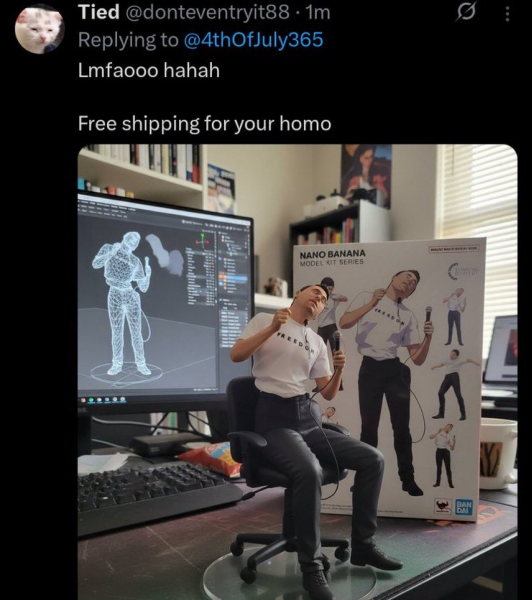
One tweet, from a now-suspended user on X, @donteventryit88, is an image of a 3D model made of the moment Kirk was shot, with the figure showing a slumped-over Kirk with blood pouring out of his neck.
Another tweet, posted a week following Kirk’s assassination, uses a freeze-framed image from the moment before the shooting and has the caption, “tried nonchalant gimmick with a girl i havent spoken to in awhile and she switched out all 3 classes we had together.” The post, by @awesomedudeguy7 on X, has 114k likes and 12.6M views.
https://x.com/awesomedudeguy7/status/1968459904198361577?s=46
Kirk’s assassination is not the first violent clip shared around social media as a meme. In 2020, a 33-year-old man named Ronnie McNutt killed himself on Facebook Live. Though Facebook deleted the original video, clips quickly spread throughout TikTok and X. In some cases, the graphic video was hidden in seemingly normal videos, starting off with people’s pets or other average internet content.
What is desensitization?
Desensitization is, as defined by Science Direct, “a gradual emotional and physiological reduction in sensitivity to violence, resulting from repeated exposure to violent media, which may lead individuals to be less likely to intervene in real-life violent situations and experience lower arousal to violent stimuli.”
Desensitization, resulting from violent media, has links to increased aggressive and violent behavior, adding to pre-existing mental health and social struggles.
Emotional Impacts of Desensitization
The issue of emotional desensitization to violent content in media has been researched for decades, starting in the early 1960s with the growing prevalence of Television. Within the past 60 years, as TV, movies, and later, the inventions of the computer, cell phone, and social media have become everyday staples in many people’s lives, exposure to violence has increased exponentially. This, in addition to the increase of real-life violence many, especially adolescents, are exposed to through an increase in mass shootings, has had detrimental effects on mental health.
A study done in 2017 by the Association of Computing Machinery, which focused specifically on reactions to gun violence on X, showed there was a decline in negative emotions in tweets about mass shootings from 2012 to 2014. However, despite desensitization, feelings of disgust and anxiety still increased.
“Despite the overall desensitization trend, people show a significant decrease in disgust, sadness, and anger, yet notable increase in anxiety towards gun violence,” the study says. “The results provide evidence for longitudinal emotional desensitization, and call for more careful conceptualization of the term.”
In a 2011 National Institute of Health (NIH) study, a group of 303 people was studied during two weeks of regular media violence exposure, as well as being shown a sad or funny clip for comparison. Results showed the reactions towards the sad or funny clips wholly differ from the responses to violence, meaning there is a unique form of desensitization from violent media.
“No relations were found between habitual media violence viewing and arousal in response to the sad and funny film clips, and arousal in response to the sad and funny clips did not predict aggressive cognitions or aggressive behavior on the laboratory task,” the study said. “This suggests that the observed desensitization effects are specific to violent content.”
Social Impacts of Desensitization
It is unknown if desensitization itself impacts interpersonal relationships or personality. Dr. Jane Halonen, a Psychology professor from the University of West Florida, said when asked how desensitization impacts personality traits, it would be difficult to learn because the research would be incredibly difficult.
“The problem here is that there is no easy way to test the specific impact of desensitization on personality traits,” Dr. Halonen said. “Desensitization would probably take a toll on ‘conscientiousness,’ ‘openness to experience,’ and ‘agreeability’ but I’m not sure how easy this research would be to pull off.”
However, desensitization still has some specific links to other social psychology theories.
In a discussion with Catherine Jones, licensed psychologist at Mended Wing in Pensacola, FL, she discussed how desensitization impacts social interaction.
“It’s definitely impacted the way that people interact with each other. “Sometimes, I see people being more generous with each other, but less generous with people who do not have the same system,” Jones said. “So, if they have a very strong feeling about a school shooting, and somebody else has a different opinion on it, then I can see that it gets very ugly very quickly.”
Dr. Halonen said desensitization is also linked to the bystander effect.
“Unfortunately, as we have seen in recent examples in the media, desensitization may strengthen what psychologists refer to as the bystander effect,” Dr. Halonen said. “When confronted with someone else’s crisis (e.g., getting stabbed on the subway), we choose noninvolvement, sometimes assuming that someone else will come to the rescue or we just identify that we just don’t want to get involved.”
Impacts on Criminal Behavior
Some studies show that the desensitization towards violence, as a result of the media, has links to an increase in violence.
One study from the University of Lahore, published in 2025, says desensitization creates communal aggression, but is not linked to criminal acts themselves.
“The findings suggest that community violence fosters aggression through desensitization and peer influence, family violence increases the risk of criminal behavior through psychological distress and normalization of violence and media violence influences attitudes but lacks a direct causal link to criminality,” the study says.
In an interview with Dr. Nicholas Hasan Buker, Professor and chairman of the Department of Criminology at UWF, Dr. Buker said that while violent media may increase aggression, there are few links to it impacting real-life crime.
“Repeated exposure to violent media can blunt emotional reactions to violence and nudge some people toward more aggressive thoughts or minor aggressive acts,” Buker said. “But translating those effects into serious criminal behavior or population-level crime rates is far less clear.”
When asked about copycat crimes, where viral criminal acts encourage others to participate, Dr. Buker said that while they do occur, they’re hard to keep track of because of the record process.
“Case studies and reviews document crimes where offenders emulate methods, targets, or narratives publicized in news or entertainment; however, copycat events are not systematically recorded, and quantifying their prevalence is difficult,” Buker said. “Contemporary reviews note that media can provide scripts that some offenders adopt, especially when they identify with perpetrators or seek notoriety; still, copycatting is not a dominant driver of overall crime trends.”
Dr. Buker also noted the impact violence on Social Media has, with it impacting the social lives of adolescents, even if no crimes are committed.
“The adolescent context is distinctive: social media can act as a ‘vector’ that normalizes aggression, escalates conflicts, and increases some risky conduct, even as most youth will not become seriously violent,” Dr. Buker said.
Media Impacts on Desensitization
Fictitious violence is not the only form of media impacting desensitization and mental health struggles.
In a 2023 article, a study found that when 607 people were sent headlines about a company’s wrongdoings, after 15 days, they started to care significantly less.
“Extending prior laboratory research, these findings reveal that repetition can have a lasting effect on moral judgments in naturalistic settings, that affect plays a key role, and that increasing the number of repetitions generally makes moral judgments more lenient,” the study says. “The more times we hear about a wrongdoing, the more we may believe it—but the less we may care.”
Additionally, in a 2024 Pew Research Center survey, they found the news media reports on violent crime more than almost any other subject.
“Roughly three-quarters of adults (77%) say they often or sometimes get local news and information about crime,” the survey says. “That’s more than say the same about traffic (68%), government and politics (68%), arts and culture (59%), the economy (59%), schools (56%) and sports (54%).”
News media, though intended to simply deliver facts to those at home, may add to the issue of desensitization through the amount of reporting on criminal acts and violence.
Amanda Stewart, Executive Producer at WEAR-ABC 3, discussed in an interview how the media decides what to show on broadcast news.
She said as a journalist, her job is to decide what is newsworthy and what creates the least harm.
“The big question to ask is – how relevant are the details, and how relevant are the visuals when it comes to effectively and accurately telling the story? Sometimes you can get the big picture across without using graphic details. Other times, people might need to see it to understand. Also consider the stakeholders – the victims, their families, etc,” she said. “It’s a fine line to walk – you have to consider the public’s right to information about their community and the impact of what you’re reporting (and how you’re reporting it). If you can check those boxes, you’ve likely avoided glorifying violence.”
When asked how the media can limit their role in adding to desensitization, Stewart advised to use critical thinking when sharing the necessary details.
“My advice is don’t be scared of telling the whole story – and consider your role. If we sanitize every detail in a violent story – the whole impact of those violent events can’t be appreciated. There are lines you can cross, so stay aware of those,” she said. “Consider the public’s right to information and why knowing certain details – or seeing certain elements – may benefit them as members of the community. On the other side of the coin – don’t show things or detail facts for the sake of engagement or “clicks”. When you omit something – disclose that you did and explain why.”
How Can We Prevent It?
Dr. Halonen discussed how desensitization, because mental health is multi-factoral, is difficult to specifically treat in therapy, but therapy can still help.
“Pinpointing desensitization as the cause of mental disturbance would be a tricky business since mental health challenges arise from many factors,” Dr. Halonen said. “However, if people are feeling disconnected from others and “dulled” emotionally, then many positive psychology interventions can help improve this problem. For example, embarking on a random kindness campaign or making a point to write letters of gratitude to those who have been helpful to you might be ways of getting out of the dark hole.”
Jones, a therapist, discussed what she does to help patients suffering from desensitization.
“I have a lot of times what I do is I’ll teach grounding,” Jones said. “Feel something to get them out of their head and back into their body, so they can recognize the impact that the stress they’re taking in has on them.”
Dr. Halonen also recommended taking time away from social media as a preventative measure.
“Make it a point to be fully present when in the company of real (rather than digital) people will be much more fulfilling and much less likely to result in disturbing exchanges that the social media world thrives on,” Halonen said.
Dr. Buker also provided preventative measures families can take if their children are impacted by desensitization from violent media.
“(1) Pair media-literacy and trauma-informed practices with early-warning supports (e.g., monitoring conflict signals online). (2) Encourage prosocial norms and rapid de-escalation channels (trusted adults, restorative approaches),” Dr. Buker said. “(3) Reduce algorithmic exposure to violent content where possible; treat weapon-display content as a risk flag. (4) Focus most on known criminogenic risks (family violence, peer delinquency, substance misuse), where the evidence for crime prevention is strongest.”