Long-term Covid-19 effects, the 2020 pandemic shutdowns, and a rapid surge in technology use have reshaped the lasting physical, mental, and social development of children and young adults, according to a growing body of research.
The 2020 pandemic was a major event that impacted all generations, but researchers state will most influence Generation Z (born between 1997 and 2012) throughout their lives because the global disaster occurred at a stage of development when life-long values, habits, and skills were being shaped.
Covid linked to loss in IQ
Associate professor of neurology Adam de Havenon of the Yale School of Medicine and author of the 2025 Yale study A growing number of U.S. adults report cognitive disability, has stated that “challenges with memory and thinking have emerged as a leading health issue reported by U.S. adults.”
Young adults in particular (18 to 34) are increasingly self-reporting cognitive disability (difficulty concentrating, remembering, or making decisions), a rate that has escalated over a decade from 5.1 percent in 2013 to 9.7 percent in 2023.
A study from the National Library of Medicine echoes that “modest cognitive decline occurred with the original virus and with each viral variant,” including alpha and omicron.
The research suggests that a loss in IQ was evident in participants who even had mild Covid-19 with resolved symptoms, and reinfection contributed an additional loss in IQ.
“Participants with unresolved persistent symptoms had the equivalent of a 6-point loss in IQ, and those who had been admitted to the intensive care unit had the equivalent of a 9-point loss in IQ … Memory, reasoning, and executive function tasks were the most sensitive indicators of impaired function.”
The research also indicates that vaccinations provided a small advantage in cognitive impacts.
The pandemic’s lasting impact on mental health
The CDC has also determined that “the COVID-19 pandemic has exacerbated the ongoing children’s mental health crisis” in their public health study, Pandemic’s Impact on Children and Teens Studied, published in early 2026.
While less prone to severe illness, the 2020 lockdowns and distancing measures aimed at containing the Covid-19 virus had a profound impact on the daily lives of young people globally.
Children and young adults experienced disruptions in their education, leisure, and social interactions with family and peers, which in turn disrupted multiple areas of development.
The review The Impact of the Covid-19 pandemic on adolescent mental health across the world published by Science Direct in 2023 revealed significant effects of the pandemic on mental health, and specified that “pre-pandemic risk factors amplified the vulnerability” of children and young adults. This is particularly true for individuals in lower income middle class demographics.
Increased classroom screen exposure harm student learning outcomes
In January of this year, Dr. Jared Cooney Horvath testified before the U.S. Senate Committee on Commerce, Science, and Transportation, stating “over the past two decades, the cognitive development of children across much of the developed world has stalled and, in many domains, reversed.”
While digital tools permitted continued instruction and offered innovative learning resources during the 2020 pandemic,”the available evidence shows that increased classroom screen exposure is generally associated with weaker learning outcomes, not stronger ones.”
Digital tools can support surface-level skill gain, “but in most core academic contexts, screens slow learning, reduce depth of understanding, and weaken retention.”
Horvath stressed that it’s not that digital tools are inherently unhealthy, but implementation matters, and application needs to be re-assessed.
2024 Study rates Florida’s eighth-grade reading levels 44th in the nation
In a 2024 assessment by the National Assessment of Educational Progress (NAEP), Florida ranked 44th in eighth grade reading.
The Florida Educational Association (FEA) responded in a statement that these results are “the long-term consequences of decades of underinvestment, overburdened educators, and bad policies that fail to support students equitably. Rather than listening to the experts… leaders have ignored their voices, undermining the respect these professionals deserve an the critical role they play in student success.”
These findings follow Florida Department of Education’s early 2020 eradication of the Common Core initiative and implementation of the Benchmark for Excellent Student Thinking (B.E.S.T) Standards for English Language Arts and Mathematics in the Florida education system, lead by Governor Ron DeSantis.
A steady decline in literacy in adolescents and young adults
Over exposure to digital media is directly linked to impairing children and young adults thinking and learning abilities.
In a study published by Young Thinkers Review on Research on adolescents’ new media literacy and its cultivation by Min-joon Han, Ji-eun Ryu, and Anna Schulz, “new media has certain adverse effects on the construction of a systematic knowledge system and the development of reading, learning, thinking, and critical abilities in adolescents.”
Educators now grapple with the trending issue of a declining literacy rate among students. Futurism reports that some educators have lowered (or completely discarded) earlier standards and shifted their approach to engage the modern classroom.
However, with a majority of Gen Z now in their 20’s and early 30’s, there is concern about the future social impact caused by their collective critical thinking deficit, particularly in how they consume news.
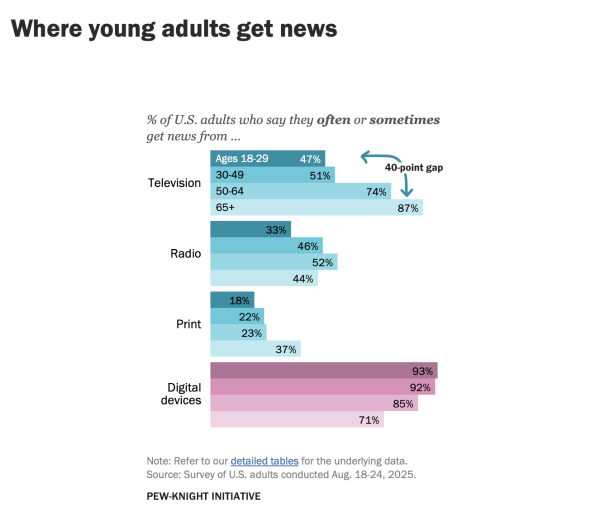
According to a study published by Pew Research, Young Adults and the Future of News by Naomi Forman-Kastz, Michael Lipka, Katerina Eva Matsa, Kaitlyn Radde, Chris Baronavski, and Justine Coleman, social media is a common place for incidental news exposure. “Young people’s increasing dependence on social media for news demands increasing levels of news literacy,” particularly with the recent integration of AI across digital media.
The study highlights that a defining characteristic of online news habits among young adults is that they tend to get their news from social media influencers. The research notes that likability and general agreement in ideology is how some young viewers discern credibility in their sources.
The path forward requires systemic change and community support
The notable decline in literacy rates and increase in digital media consumption has led to a rise in media literacy programs that aim to support abilities to critically and mindfully navigate news.
The Stern Center for Language and Learning suggests that “effective literacy instruction needs to start early and prioritize strong decoding skills. Students should be taught in deliberate, systematic, and explicit ways about sounds in words, syllable types, spelling patterns, and the meaningful parts of words.”
Parents may want to consider using reading programs at home, such as PBS Learning Media or Hooked on Phonics.
Dr. Horvath called for a more studied and balanced strategy in integrating educational technology.
The ADA suggest that “adolescents’ social media use should be preceded by training in social media literacy to ensure that users have developed psychologically-informed competencies and skills that will maximize the chances for balanced, safe, and meaningful social media use.”
Moving forward, educators, parents, advocacy groups, and policy makers are called to collaborate in prioritizing outreach and awareness, in addition to implementing systemic rehabilitation in classrooms and across communities.
However, it is up to the young adults of Gen Z to break their screen habits, seek media literacy education, and practice reading comprehension.